


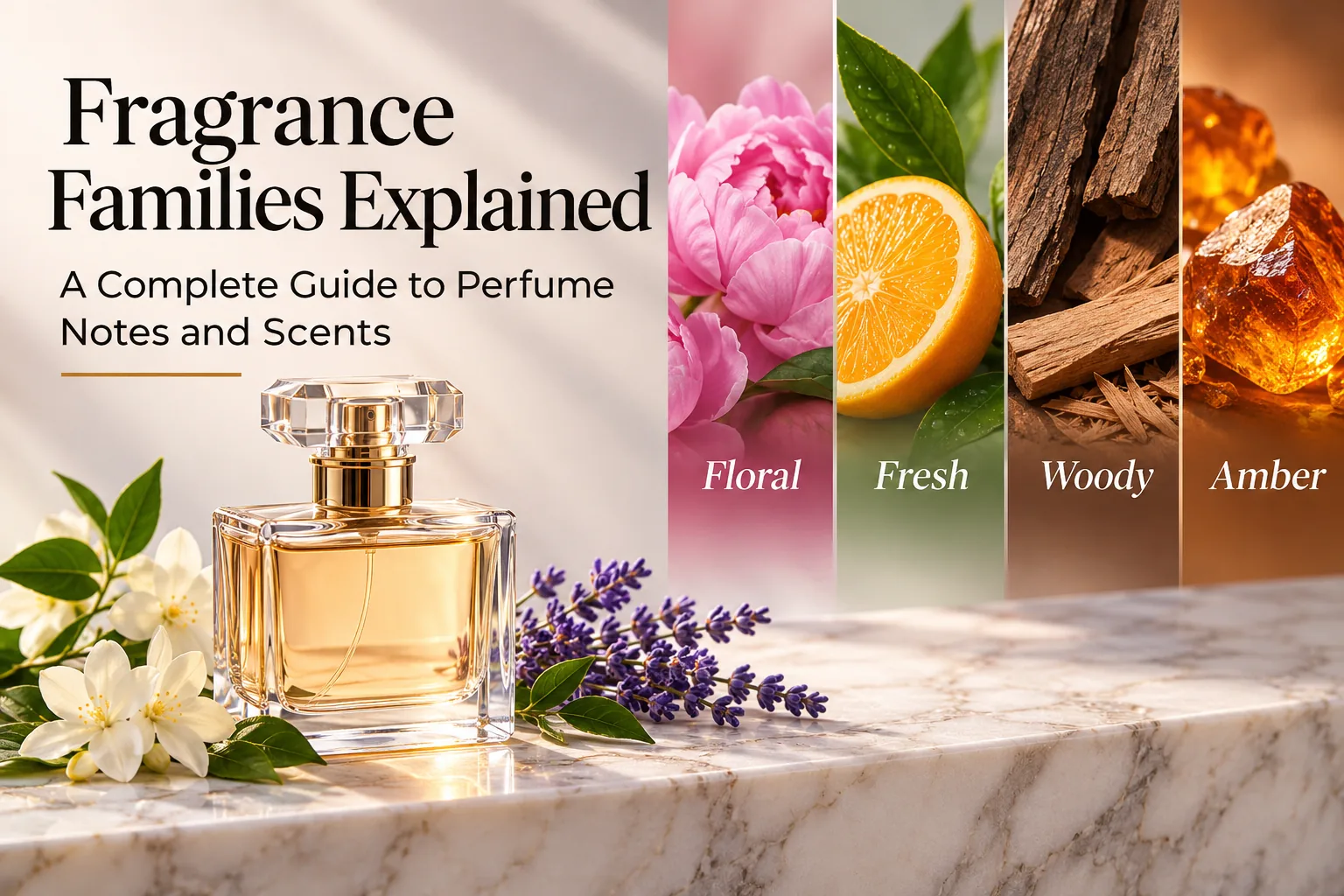
Fragrance Families Explained: A Complete Guide to Perfume Notes and Scents
Choosing a perfume becomes much easier when you understand fragrance families. Instead of navigating hundreds of bottles by brand, price or packaging alone, you can identify the types of scents you naturally enjoy and discover fragrances with similar characteristics.
Whether you prefer bright citrus, delicate flowers, creamy woods or warm vanilla, this guide explains how fragrance families work and how to use them when shopping for your next perfume or cologne.
What are fragrance families?
Fragrance families are broad classifications that describe the dominant character of a perfume. They help organize fragrances according to recognizable scent profiles rather than the individual ingredients used in their formulas.
Although classification systems vary, four commonly recognized groups are floral, fresh, woody and amber. Many fragrances combine characteristics from several families, creating compositions that are more complex than a single category suggests.
1. Floral fragrances
Floral fragrances feature scents associated with flowers such as rose, jasmine, violet, iris, orange blossom, gardenia and tuberose. They can range from transparent and delicate to rich, creamy and dramatic.
Common floral styles
- Fresh floral: light petals combined with citrus or green notes.
- White floral: richer compositions featuring jasmine, gardenia or tuberose.
- Powdery floral: soft textures associated with iris, violet and musk.
- Fruity floral: flowers combined with fruit accords such as pear, peach or berries.
Floral fragrances are versatile. A light floral composition may work beautifully during the day, while a richer floral can complement evening occasions.
2. Fresh fragrances
Fresh fragrances emphasize brightness, cleanliness and an airy character. Citrus, aromatic herbs, green leaves and aquatic accords frequently appear in this family.
Common fresh styles
- Citrus: bergamot, lemon, grapefruit and mandarin.
- Aquatic: marine, watery and airy accords.
- Green: leafy, grassy and botanical impressions.
- Aromatic: herbs such as lavender, rosemary and sage.
Fresh scents are popular choices for warm weather, daytime wear and environments where a lighter fragrance is desirable. However, freshness does not necessarily mean weak performance. Concentration, composition and application all influence how a fragrance develops.
3. Woody fragrances
Woody fragrances are built around the character of materials and accords such as cedar, sandalwood, vetiver, patchouli and oud. They can feel dry, earthy, smoky, creamy or resinous.
Common woody styles
- Dry woods: cedar and vetiver with a crisp, earthy character.
- Creamy woods: smooth sandalwood-style accords.
- Woody aromatic: woods combined with herbs and fresh notes.
- Woody amber: warm woods blended with spices, resins or vanilla.
Woody fragrances can be understated and professional or bold and expressive. Their versatility makes them useful when building a fragrance collection for different occasions.
4. Amber fragrances
Amber fragrances, historically also called oriental fragrances, are associated with warmth, richness and sensuality. They frequently combine vanilla, benzoin, labdanum, spices, balsamic accords and woods.
Amber in perfumery usually refers to an accord rather than the smell of fossilized amber. Different perfumers interpret this accord in different ways, from soft sweetness to dark resinous warmth.
Common amber styles
- Soft amber: gentle vanilla, powdery and balsamic impressions.
- Spicy amber: warm spices combined with resins or sweetness.
- Woody amber: woods supported by rich amber accords.
- Floral amber: flowers combined with warm, enveloping base notes.
Many people enjoy amber fragrances during cooler weather and evening occasions, although lighter amber compositions can be suitable throughout the year.
Other important fragrance styles
Gourmand
Gourmand fragrances evoke edible aromas such as chocolate, caramel, coffee, vanilla and praline. They may overlap with amber, fruity or woody families.
Chypre
Traditional chypre compositions contrast citrus brightness with floral, mossy, earthy or woody depth. Modern interpretations vary considerably.
Fougère
Fougère fragrances commonly combine lavender, coumarin and mossy or woody elements. The name means fern in French, although the style does not literally reproduce the smell of a fern.
Understanding top, middle and base notes
Fragrance notes describe recognizable scent impressions. They are not necessarily a complete list of the ingredients in a perfume.
- Top notes: the initial impression, often featuring bright citrus, herbs or light fruits.
- Middle notes: the developing heart of the fragrance, frequently containing flowers, spices or aromatic accords.
- Base notes: the deeper character that becomes prominent during the dry-down, often featuring woods, musk, vanilla or resins.
These stages overlap rather than appearing at precise intervals. Testing a fragrance over several hours gives you a better understanding of its character than judging the opening alone.
How to choose your fragrance family
Start by identifying scents you enjoy outside perfumery. Do you like freshly cut citrus, garden flowers, polished wood, aromatic herbs or warm desserts? These preferences can provide a useful starting point.
| Your preference | Families to explore |
|---|---|
| Clean and refreshing | Fresh, citrus, aquatic |
| Soft and romantic | Floral, powdery floral |
| Earthy and sophisticated | Woody, chypre |
| Warm and comforting | Amber, gourmand |
| Herbal and classic | Aromatic, fougère |
Explore fragrances at PerfumesLA
Use the following fragrances as starting points for exploring different scent profiles. Availability, bottle sizes and concentrations may vary.
- Amouage Reflection by Amouage 3.4 oz EDP Men — Explore a floral and woody composition.
- Creed Aventus by Creed 3.3 oz EDP for men — Explore a fruity and woody composition.
- Shalimar by Guerlain — Explore a classic amber fragrance.
- Black Orchid by Tom Ford for Women — Explore a rich, dark floral composition.
- CK One by Calvin Klein for Unisex 3.4 oz — Explore a fresh citrus-aromatic style.
You can also explore our complete collections of perfumes for women, colognes for men and mini fragrances.
Frequently asked questions
Can a perfume belong to more than one fragrance family?
Yes. Many perfumes combine floral, woody, fresh and amber characteristics. Classification depends on the dominant impression and the system being used.
Which fragrance family lasts the longest?
No family guarantees a particular wear time. Rich woods, resins and musks can contribute to persistence, but the complete formula, application and individual skin characteristics also matter.
Are woody fragrances only for men?
No. Fragrance families are not restricted by gender. Anyone can enjoy woody, floral, fresh or amber fragrances.
What is the best fragrance family for beginners?
Fresh and lighter floral fragrances can be approachable starting points, but personal preference matters more than any universal recommendation. Sampling several styles is the best way to discover what you enjoy.
Find your signature scent
Understanding fragrance families gives you a practical vocabulary for exploring perfume. Use these categories as a guide, experiment with different compositions and allow each fragrance time to develop before deciding whether it belongs in your collection.