


Eau de Toilette vs. Eau de Parfum: What Is the Difference?
Choosing a fragrance often starts with a scent you love, but the label can raise another question: should you buy eau de toilette or eau de parfum? These terms describe different fragrance categories, commonly abbreviated as EDT and EDP. They offer a useful starting point for understanding how a perfume may wear, but they do not tell the whole story.
An eau de parfum generally contains a higher proportion of aromatic ingredients than an eau de toilette. That difference can influence the way a fragrance feels and how long it remains noticeable. Still, concentration is only one part of the formula. The ingredients, your skin, the weather, and even where you apply the fragrance can all affect the result.
Eau de toilette vs. eau de parfum at a glance
| Feature | Eau de Toilette (EDT) | Eau de Parfum (EDP) |
|---|---|---|
| Concentration | Generally lower | Generally higher |
| Character | Often lighter in style | Often fuller in style |
| Longevity | Varies by formulation | May last longer, but not guaranteed |
| Projection | Depends on the fragrance | Depends on the fragrance |
| Best use | Any occasion that suits the scent | Any occasion that suits the scent |
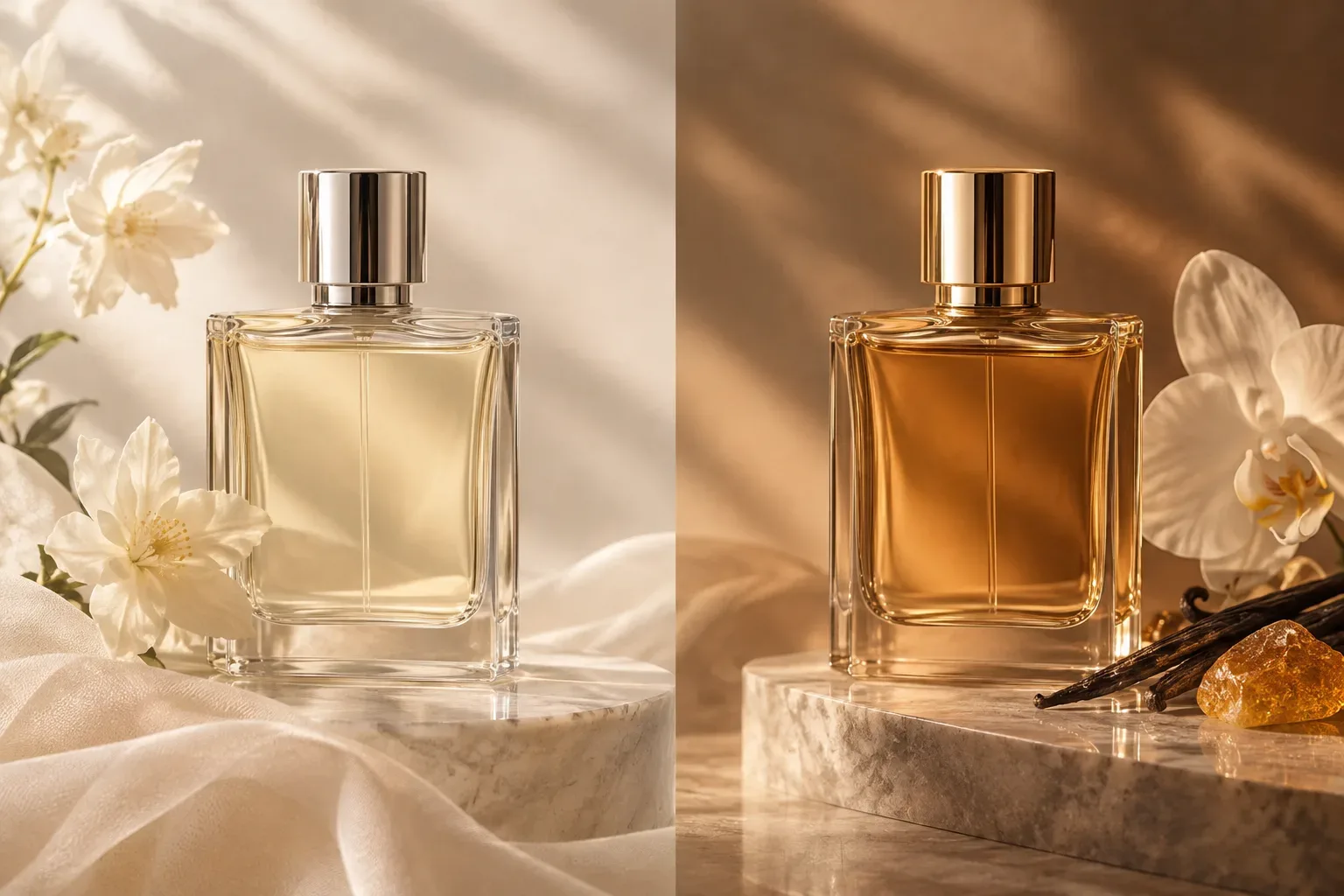
The featured artwork is conceptual. Bottle design and liquid color do not indicate fragrance concentration.
What do EDT and EDP mean?
Eau de toilette and eau de parfum are names used to describe types of fragrance. Both are typically made by blending aromatic materials with a carrier, often alcohol, along with other ingredients that support the finished formula. The difference usually lies in the proportion of aromatic material and the creative choices made when composing the scent.
EDT is often positioned as a lighter interpretation, while EDP is often presented as a more concentrated one. Those descriptions are useful generalizations, not strict rules. There is no single concentration range that applies universally to every EDT or EDP on the market, and a label alone cannot predict exactly how a fragrance will behave.
Concentration and formulation: related, but not identical
Concentration refers broadly to the amount of fragrance material in the finished product. In many product lines, an EDP has a higher concentration than an EDT. However, two fragrances with different labels can overlap in concentration, and brands do not always disclose an exact percentage.
Formulation is a broader concept. It includes the aromatic materials selected, their proportions, and the way they interact with the rest of the product. Some materials are more volatile and noticeable early in a wear; others tend to remain perceptible for longer. A fragrance built around lighter-smelling materials may create a different impression from one built around heavier-smelling materials, regardless of the label.
When a fragrance is available in both EDT and EDP versions, do not assume one is simply the other with more or less fragrance added. A brand may adjust the composition to create a different interpretation. The two versions might share a recognizable identity while developing differently on skin. Check the product description and, whenever possible, smell each version before deciding.
If you are learning how fragrances are grouped by their overall character, our guide to fragrance families can help you describe what you enjoy. A family describes a scent’s character; EDT and EDP describe its concentration category. The two concepts answer different questions.
Longevity: how long does the scent last?
Longevity is the length of time you can perceive a fragrance after application. EDPs are often expected to last longer than EDTs, but that is a tendency rather than a guarantee. A particular EDT may outlast a particular EDP because of differences in their ingredients and construction.
Wear also varies from person to person. Skin characteristics, the amount applied, application area, and environmental conditions can change how a fragrance develops. A scent may remain on clothing differently than it does on skin, too. In addition, your own perception can change as you become accustomed to a smell, so finding it harder to notice does not necessarily mean it has disappeared entirely.
Instead of relying on a promised number of hours, evaluate a fragrance over a normal day. Notice its opening, check it again after some time, and see whether you still enjoy the later stages. For an evening scent, try it through the kind of evening you would actually wear it.
Projection and presence
Projection describes how far a fragrance seems to travel from the person wearing it. A scent with more noticeable projection may be apparent to people nearby, while a quieter one may stay closer to the skin. Projection is distinct from longevity: a fragrance can become subtle relatively quickly yet remain detectable at close range for longer.
An EDP is not always the louder option. The blend, the quantity sprayed, and the setting all influence its presence. Likewise, an EDT can make a noticeable impression. Consider whether you want a scent primarily for your own enjoyment, a subtle presence in a shared space, or something more expressive for an event.
When testing, start conservatively. You can usually add another spray, but an overly generous application is harder to undo. Ask yourself whether the fragrance feels comfortable at a normal conversational distance rather than judging it only with your nose against your wrist.
How to apply EDT and EDP
The same basic approach works for both categories: begin with a small amount and adjust according to the fragrance and the situation. One or two sprays may be enough for some products and preferences; others may call for a different approach. There is no spray count that works for every formula.
- Apply to clean skin, following the product’s directions and avoiding irritated or broken areas.
- Try an area such as the wrist, neck, or inner elbow, where you can observe how the scent develops.
- Let the fragrance settle rather than rubbing your wrists together immediately after application.
- If you apply fragrance to clothing, check the care label and test an inconspicuous area first, as products may mark or affect fabrics.
- Store the bottle away from direct sunlight and excessive heat, with the cap in place, to help protect the fragrance.
If you enjoy reapplying during the day, a lighter-feeling EDT may fit that routine. If you prefer to apply once and see how the scent evolves, an EDP may be worth exploring. Neither approach ensures a particular wear time; the specific product and your experience should guide you.
Choosing for climate and occasion
Warm weather and close spaces
Heat and humidity can change how a fragrance is perceived. In warm conditions, or in a crowded room, a scent may feel more noticeable than it did in a cool, open space. An EDT can be appealing when you want a lighter impression, but the composition and number of sprays still matter. A restrained application of an EDP may also work well.
Cool weather and evenings
In cooler weather, some people enjoy a fragrance with a fuller presence, and an EDP may be a comfortable choice. That does not mean an EDT is unsuitable for winter or evening wear. Choose the version you like on your skin, then adjust your application to the setting.
Work, travel, and special events
For an office, airplane, or other shared environment, consider keeping your fragrance subtle out of courtesy to the people around you. A celebration or an outdoor event may give you more room to wear a noticeable scent. Occasion is a useful guide, but it is not a rulebook: your preferred fragrance should feel appropriate to you and considerate of the space.
How to sample before you buy
A paper strip is helpful for a first impression, especially when comparing several fragrances, but skin testing gives you a more personal picture. If you can, try one version on each wrist or test them on separate days. Make a note of which is which, and avoid applying several fragrances close together, where they can be difficult to distinguish.
Give each scent time to develop. The first few minutes reveal only the opening; the character you live with later may be different. Check in after an hour or two and again later in the day, without assuming that your experience will match someone else’s. If possible, sample in the weather and settings where you expect to wear the fragrance.
When comparing an EDT and EDP from the same collection, focus on the actual differences you notice. Do you prefer one opening? Does one feel more comfortable at the distance you want? Is the later scent something you would enjoy wearing regularly? These observations are more useful than buying solely by concentration label.
Shopping considerations and examples
Before purchasing, check the full product name, stated concentration, bottle size, and intended format. Similar names can appear across different versions, and a listing may offer more than one option. Confirm the selection on the product page rather than assuming that every fragrance in a collection is an EDT or EDP.
For a starting point among the verified listings, compare the category labels on these products:
- Acqua Di Gio by Giorgio Armani, 3.4 oz EDT for Men is an eau de toilette listing.
- Creed Aventus by Creed, 3.3 oz EDP for Men is an eau de parfum listing.
- Amouage Reflection by Amouage, 3.4 oz EDP Men is another eau de parfum option.
- Flowerbomb by Viktor & Rolf for Women is another fragrance to explore; check the product page for the available specifications.
These are different fragrances, not interchangeable versions of the same scent. Comparing them can introduce you to the labels and available choices, but it cannot isolate the effect of concentration. For a closer EDT-versus-EDP comparison, sample two versions of the same fragrance when they are available.
Also consider how often you plan to wear your purchase. A smaller bottle may suit someone who likes variety or is still exploring, while a larger size may appeal when you have already tested a fragrance and know you enjoy it. Review the current listing details and return terms before ordering, especially if you are buying without sampling.
Which should you choose?
Choose an eau de toilette if its scent, feel, and application style suit you. Choose an eau de parfum if you prefer that version’s character and the way it wears. Either can be appropriate for daily use or a special occasion; neither label guarantees a specific level of performance.
The most reliable comparison is a personal one: check the product details, sample on skin when possible, and give the fragrance time to develop in your own environment. The best choice is the one you enjoy wearing, not simply the one with the concentration name you expected to prefer.