


How to Store Perfume and Extend Its Shelf Life
The best way to store perfume is in a cool, dry place away from direct sunlight and frequent temperature changes. Keep the bottle closed, upright and, when practical, inside its original box. A bedroom drawer or a shelf in a closed closet is usually a better choice than a sunny windowsill or a steamy bathroom.
Good storage can help slow changes in a fragrance, but it cannot make perfume last forever. There is no universal expiration date: ingredients, formulation, packaging and handling all influence how a scent changes over time. Here is how to protect your collection and recognize when a fragrance may have deteriorated.
Why perfume storage matters
Perfume is a mixture of aromatic materials and other ingredients, commonly including alcohol. Its composition can change gradually as it is exposed to oxygen, light and heat. These changes may affect the scent’s opening, balance or overall character. Some fragrances remain enjoyable for a long time; others noticeably change sooner.
Storage is only one part of the picture. A bottle’s design, how often it is opened and the ingredients in the formula also matter. You cannot determine a perfume’s condition simply by looking at its concentration label or counting the years since purchase.
Fragrance performance on skin is a separate question. How strongly a perfume projects and how long it is noticeable vary with the formulation, your skin and the environment. A scent that seems faint on a hot day, for example, is not automatically spoiled.
Choose a cool, dark and stable location
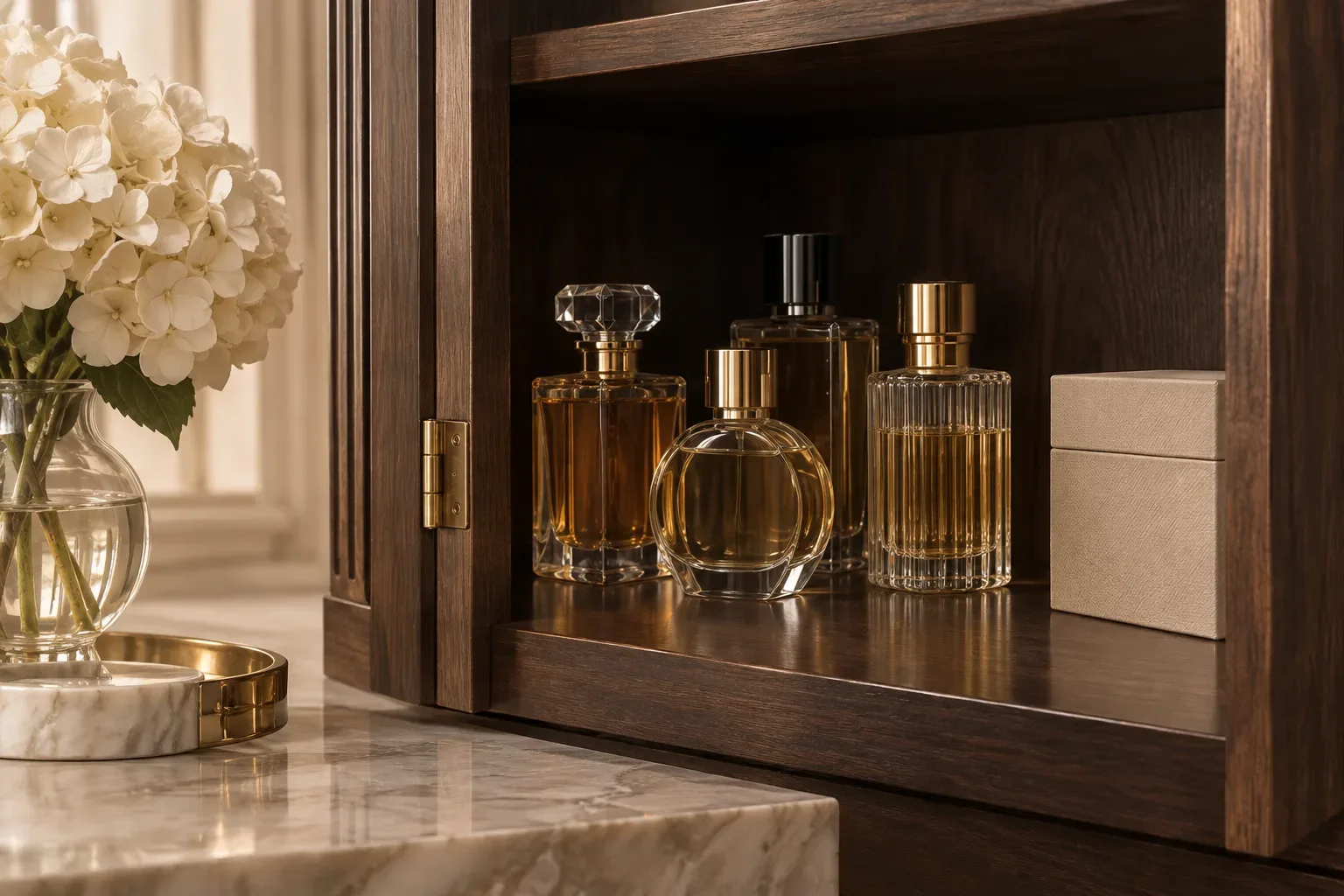
Look for a place that stays reasonably consistent in temperature and is protected from direct light. A closed closet, dresser drawer or cabinet away from a radiator can work well. Keep bottles where they will not be knocked over, and avoid tightly packing them against items that could damage the sprayers.
Darkness helps limit light exposure, while a stable indoor temperature avoids the repeated warming and cooling that can stress a fragrance. You do not need specialized equipment to store most perfumes: a sensible spot in your everyday living space is generally more useful than an elaborate display beside a window.
Why sunlight is a problem
Direct sunlight can expose perfume to both light and heat. Over time, light may contribute to changes in ingredients and color. Even if a bottle is made from tinted or opaque glass, avoid assuming it blocks all damaging light. Place it inside a cabinet or its box rather than relying on the bottle alone.
A vanity may look attractive in daylight, but a bottle sitting in a sunbeam for hours is better moved. If you enjoy displaying your collection, choose an area out of direct sun and away from heat sources, or display empty bottles instead.
Why heat and temperature swings matter
Heat can speed up chemical changes in fragrance. Avoid leaving bottles near heaters, on top of electronics, beside a stove or in a parked car. Temperature fluctuations are also a reason to be cautious about storing perfume in places that repeatedly become hot and cool.
The bathroom is convenient, but showers can make it warm and humid, especially when ventilation is limited. A closed cabinet in a more stable room is usually a better everyday option. If the bathroom is your only practical choice, keep the bottle closed, away from the shower and out of direct light.
Limit air exposure and handle bottles carefully
Oxygen can react with fragrance ingredients, gradually altering the scent. A spray bottle generally limits direct contact with air during normal use, so there is no need to stop using your perfume. The useful habit is to avoid leaving bottles open or transferring the liquid unnecessarily.
- Replace the cap after use to protect the sprayer and reduce the chance of accidental discharge.
- Keep stoppers and screw caps properly closed between uses.
- Store bottles upright to reduce the risk of leaks.
- Avoid repeatedly opening a dab bottle or touching its contents with your fingers.
- Use a clean travel atomizer if you decant, and transfer only what you expect to use.
A cap does not necessarily make an atomizer airtight; the sprayer and bottle construction also matter. Likewise, shaking perfume is not needed before ordinary use. Handle the bottle gently and follow any specific instructions from its manufacturer.
Should you keep perfume in its original box?
Yes, if you have the space. Original packaging provides another barrier against light and can help protect the bottle from bumps. It can also keep useful identifying information together, including a batch code or any storage guidance printed on the packaging.
A box is not a substitute for a suitable location. A boxed bottle left in a hot car or on a sunlit windowsill can still get warm. Put the box in a cool, dry cabinet or drawer, and keep it away from places where it might get crushed or damp.
If you have discarded the box, do not worry. A closed drawer or cupboard can still provide darkness. Keep the bottle upright and leave enough room around the sprayer and cap to avoid accidental damage.
Is the refrigerator a good place for perfume?
Refrigeration is not necessary for most fragrances. For everyday storage, a consistently cool room away from sunlight is a simpler choice. A household refrigerator can introduce repeated temperature changes if a bottle is taken in and out frequently, and it may expose packaging to moisture.
If a manufacturer gives specific storage instructions, follow those first. Otherwise, avoid freezing perfume or moving it repeatedly between temperature extremes. A stable, dark cupboard is a practical default rather than a promise of a particular shelf life.
How to tell if perfume has deteriorated
Start by comparing the fragrance with how you remember it when it was fresh. A meaningful change in smell is often more useful than a date alone. Spray a little on a clean paper strip and allow it to develop before deciding; the first few seconds do not always represent the whole scent.
- A noticeably sour, harsh or unusual smell: The fragrance may smell different from its familiar character, rather than merely opening with a strong burst of alcohol.
- A changed balance: The opening may seem muted or the scent may no longer develop as you remember.
- A substantial appearance change: Darkening, cloudiness or visible particles can warrant a closer look, especially if the change is new.
- A damaged or leaking bottle: A loose sprayer, broken seal or leak can make the contents more vulnerable to exposure and contamination.
None of these observations alone provides a universal test. Some formulas naturally deepen in color, and lighting or the bottle itself can change how the liquid looks. A scent can also smell different on paper and skin, or to a nose temporarily fatigued by repeated smelling.
If the odor is distinctly unpleasant, the liquid looks unusual or you are unsure about its condition, avoid applying it. Stop using any product that irritates your skin. Do not try to fix a questionable fragrance by adding alcohol, water or another perfume.
Does perfume have an expiration date?
There is no single expiration date that applies to every perfume. Some packaging includes a date, a period-after-opening symbol or other manufacturer guidance; check the bottle and box and follow any applicable instructions. A batch code may help identify a production batch, but it is not necessarily an expiration date.
Even two bottles purchased at the same time can age differently if one sits in a hot, bright room and the other stays closed in a dark cabinet. Formulation and packaging differ too, so a fixed number of years cannot reliably tell you whether every fragrance is still in good condition.
Similarly, eau de parfum and eau de toilette labels do not guarantee how long a bottle will remain fresh or how long the fragrance will last on skin. Concentration conventions vary, and the complete formula and conditions of use matter. For more context on scent character, read our guide to fragrance families explained.
For more fragrance care advice, explore our guides to eau de toilette versus eau de parfum and making your perfume last longer.
How to store perfume while traveling
Travel exposes bottles to movement, leaks and temperature changes. For a short trip, consider taking a mini or a small amount in a travel atomizer instead of packing a full bottle. If you decant, use a clean container designed for fragrance, label it clearly and close it securely. Decanting introduces some air exposure, so avoid transferring more than you need.
Keep the container upright where possible, wrap it in a soft item and place it in a sealed pouch in case of leaks. Do not leave it on a sunny dashboard, beside a hotel-room window or inside a hot parked car. At your destination, a drawer away from heat and moisture is a useful temporary home.
For flights, check the current airline and airport rules for liquids before packing. Requirements can differ by location and whether the fragrance is in carry-on or checked luggage. A small bottle does not automatically qualify without regard to those rules.
A quick perfume storage checklist
- Location: Choose a closed closet, drawer or cabinet away from direct sunlight and heat.
- Bottle: Keep it upright, closed and protected from knocks.
- Packaging: Retain the original box when convenient, but store the box in a suitable place too.
- Daily use: Minimize unnecessary opening and avoid transferring the full contents.
- Travel: Pack a small, securely closed container in a protective pouch and check transport rules.
- Condition: Watch for notable changes in smell or appearance, and stop using a questionable product.
Choosing bottles for your routine
Storage habits should fit how you actually wear fragrance. If you like keeping a bottle at home, a full-size option such as Amouage Reflection by Amouage 3.4 oz EDP for Men or Acqua Di Gio by Giorgio Armani 3.4 oz EDT for Men can be kept in a bedroom cabinet between uses.
If you prefer a smaller bottle for a trip or want to carry less, explore Jimmy Choo by Jimmy Choo 0.15 oz EDP mini for Women or Tresor in Love by Lancome 0.16 oz EDP mini for Women. Check each bottle’s closure and protect it from leaks when packing.
Whatever the size or concentration, the same fundamentals apply: limit light, heat and unnecessary air exposure, then pay attention to changes in the fragrance itself. Consistent, straightforward care gives your perfume a better storage environment without requiring you to guess a universal expiration date.